
Housing Accessibility
Background
Housing accessibility is a vital aspect of social welfare, especially for people with disabilities, older adults, and individuals with physical, sensory, or cognitive limitations. Given that anyone may experience injury, sensory loss, or mobility impairment at some point in life, housing accessibility is a matter that concerns us all. Well-designed housing allows individuals to live independently, perform daily tasks with ease, and avoid unnecessary risks. For this reason, housing accessibility should be regarded as a fundamental pillar of an inclusive society.
In the US, efforts to improve housing accessibility have spanned decades. Three major federal laws shape accessibility in residential settings: the Fair Housing Amendments Act of 1988 (FHA), the Americans with Disabilities Act (ADA), and Section 504 of the Rehabilitation Act of 1973. These laws cover a wide range of provisions, including requirements for accessible design, accommodations in public areas, and the proportion of fully accessible housing units that must be constructed. However, the challenge is still huge. An “Accessibility Index” was introduced as identified three levels of accessibility: Level 1 (modifiable), Level 2 (livable with moderate mobility limitations), and Level 3 (fully wheelchair accessible). The results were stark: only about 33% of homes were considered modifiable, fewer than 5% were livable with moderate limitations, and less than 1% met full accessibility standards. This data illustrates the significant shortfall in housing readiness for the aging and disabled population.
China also has laws and regulations aimed at promoting housing accessibility. These rules specify, for example, that a certain proportion of units in public housing should be designed for residents with disabilities, and that barrier-free routes must connect residential buildings to essential public spaces. However, most of these standards are non-binding national guidelines, meaning they function more as recommendations than as legally enforceable mandates. As a result, implementation tends to be inconsistent and heavily dependent on local government priorities, developer incentives, and available funding. Although the US “Accessibility Index” is not directly applicable to evaluating housing conditions in China, it is reasonable to expect that the overall level of accessibility in Chinese housing would score relatively low. This is partly due to a widespread lack of public awareness about accessibility and inclusive design. In many cases, China’s approach to disability support still emphasizes caregiving and dependence, rather than fostering autonomy through built environments. To build a truly inclusive society, it is essential to shift the cultural mindset from one of passive care to one of empowering independence through accessible infrastructure, especially nowadays as more and more senior people live alone and face age-related mobility challenges. Without thoughtful, barrier-free design in residential spaces, these individuals are at greater risk of isolation, injury, and loss of dignity, which makes housing accessibility not just a design issue, but a matter of social justice and public health.
Related Researches
Some researchers analyze how well existing homes support residents’ mobility and independence. They found that many homes were not suitable, particularly in critical areas like entryways, kitchens, bathrooms, and bedrooms. The mismatch was most pronounced among older adults, people of color, and low-income households. Interestingly, residents’ reported satisfaction did not always align with objective assessments, highlighting the complex interplay between expectations, lived experience, and access.
Another study shows that several key housing accessibility features can significantly enhance indoor independence. These include step-free entrances, wide doorways, accessible routes throughout the unit, reinforced bathroom walls for grab bars, and environmental controls positioned at reachable heights.
Jordana L. Maisel from IDEA Center led a research regarding "Increasing home access: designing for visibility". They had the following conclusion.
Visitability is a movement that seeks to increase the supply of accessible housing through the inclusion of three basic structural features at the time of home construction: a zerostep entrance, wide doorways, and at least a half bath on the main floor of the home.
Marjorie Cook McCullagh in his report "How to help patients make their homes safer and more accessible as their abilities change." suggested that:
Some modifications, such as installing grab bars and removing loose rugs, can be made with little or no alteration to underlying structures; others, such as installing stairs with risers that are shorter than standard height, may involve major remodeling or are best planned before home construction begins.
And there are some other modifications like the followings.
The front steps of the house have been replaced with a ramp, which allows easy access for wheelchairs; the ramp is bordered by handrails. In the kitchen is a side-by-side refrigerator unit, easier to use than other models. Creating open, clear space under countertops and sinks improves access for people who use wheelchairs or prefer to work while seated. Adjustable-height kitchen countertops are also an option.
A shower stall with a built-in seat and a grab bar reduce the risk of falling, and a moveable, hand-held showerhead on a flexible hose permits showering at different heights.
Standard door hinges can be replaced with swingclear (offset) hinges, which provide an extra inch or two of clearance.
Lift chairs have a seat-lifting mechanism that raises a person from a seated to a standing position.
Taken together, these findings underscore the importance of integrating accessible features into home design from the outset, rather than as afterthoughts. Simple structural elements, such as zero-step entrances, wide doorways, and reinforced bathrooms, not only support independence but can also prevent injury and reduce the need for future costly modifications. The researches highlight that accessibility is not limited to specialized housing but should be a standard consideration for all homes, benefiting a wide range of users across different life stages. Ultimately, designing for accessibility is not just about meeting physical needs, but about promoting autonomy, safety, and long-term livability.
Best Practices in our Community
The community I live in, Kangjian Xincun Subdistrict, is densely populated. It covers an administrative area of 4.07 square kilometers and has a registered population exceeding 83,600. The area is characterized by a significantly aging population, with many elderly residents living alone, including a substantial number who have visual impairments. Consequently, the demand for accessible housing is expected to grow. However, since nearly all buildings in this neighborhood were constructed in the 1990s or earlier, and most apartments are too small to have widened corridors and sufficient clear space for wheelchair passage, retrofitting for accessibility presents considerable challenges. Conditions vary from house to house; therefore, individual evaluations are necessary to determine appropriate accessibility modifications for each household.
Considering the above objective conditions and the research findings mentioned in the last section, I put forward some targeted recommendations for indoor accessibility, including Floor Accessibility, Walkway Accessibility and Handrail Accessibility, which has been made into posters and posted in 25 local neighborhoods by WFLA BonVista Accessibility Club. Moving forward, we are preparing to raise funds to help families in the community carry out some housing accessibility modifications.
Floor Accessibility
- Anti-slip treatment: Use anti-slip materials and ensure that the floor remains slip-resistant even when wet.
- Color contrast: Apply contrasting colors on ramps or the edges of stairs to prevent missteps and falls.
- Pay attention to carpets: Especially small, movable rugs. Loose rugs are a significant cause of indoor falls.
- Keep floors tidy: Maintain a clutter-free floor to facilitate passage for wheelchair users and people with visual impairments. Be especially mindful of robotic vacuum cleaners!
- Level differences: Avoid floor level changes indoors as much as possible. If unavoidable, install ramps. Use continuous flooring designs and avoid threshold strips or transition bars.
Walkway Accessibility
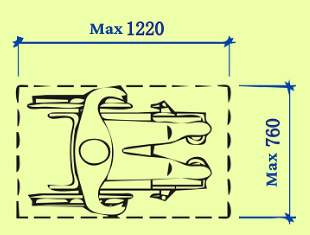
The typical dimensions of wheelchairs on the market are generally no wider than 760mm and no longer than 1220mm; for custom wheelchairs, specifications should be confirmed with the manufacturer. The width of walkways and doorways should accommodate wheelchair widths and generally should not be less than 800mm. The turning space required for a wheelchair should have length and width no smaller than the wheelchair’s length, generally not less than 1300mm.
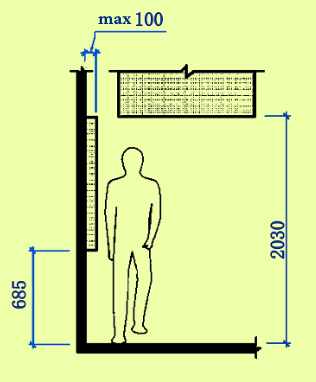
Objects fixed to walls or hanging should have a clearance from the floor of more than 685mm but less than 2030mm, and any protrusion should not exceed 100mm in thickness. For stairwells with a height lower than 2030mm, protective railings should be installed at a height not exceeding 685mm.
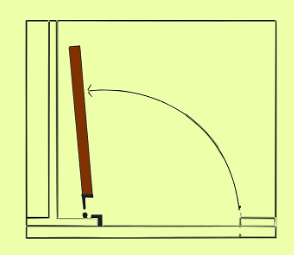
To facilitate wheelchair access, door openings generally should be no less than 800mm wide. If this cannot be achieved, sliding doors can be considered. If sliding doors are also not feasible, hinged doors with offset hinges may be used, which can typically increase the doorway width by about 50mm.
Handrail Accessibility
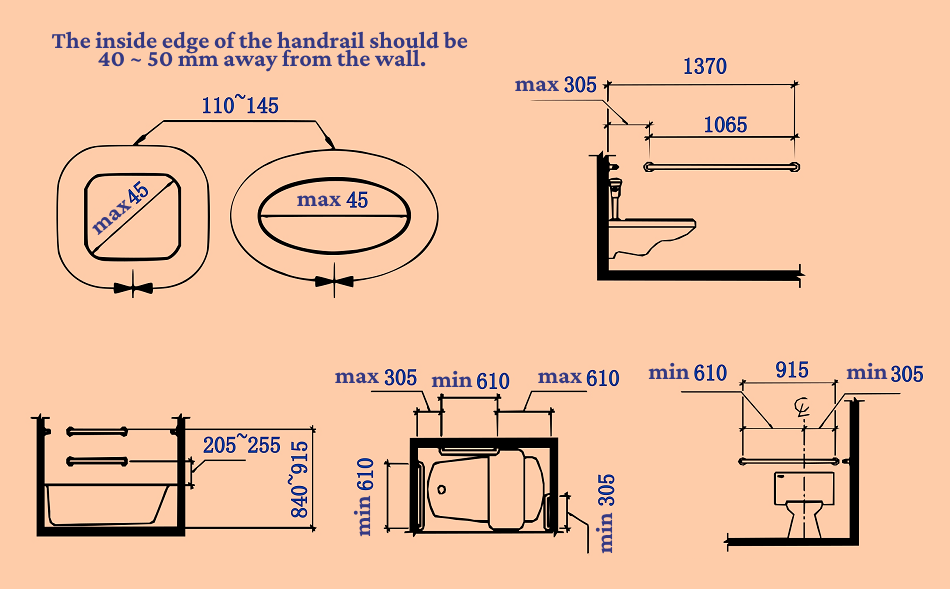
Handrail accessibility is designed to assist people with limited mobility or those who need support by providing handrails that help them maintain balance and reduce the risk of falls while moving. Typically, the installation of handrails considers factors such as height, stability, comfort, and ease of grip. Research has shown that installing handrails indoors, especially in bathrooms, can significantly reduce the risk of slipping. Additionally, because handrails are relatively inexpensive and require minimal alterations to the home, they are often prioritized in accessibility modifications.
Other Practice
In the above sections, only a few low-cost, minimally invasive indoor accessibility designs have been mentioned. In addition, considerations for wheelchair users can include low-positioned shelves, switches, and handles, as well as knee space under sinks. Where possible, installing accessible toilets is also recommended, among many other options. It is worth noting that various smart home devices are also excellent aids for accessibility!