Etiquette for Interacting with the Visually Impaired
Our Practice: Inclusive Activity with beYoureyeS
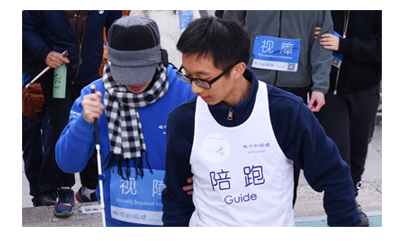
On August 18, 2024, WFLA BonVista Accessibility Club participated in the beYoureyeS weekend inclusive activity.
This was the first time for some of our club members to participate in the beYoureyeS activity. Accessibility facilitator Xiaobin Chen and Qu Wang, along with sighted facilitator Siqi Pan, who is also a member of BonVista Accessibility Club, provided training on accessibility awareness.
At the beginning of the activity, our three club members experienced teamwork while blindfolded through various games. Then, we learned the proper etiquette regarding assisting visually impaired persons, such as going up and down stairs. The key point to guiding visually impaired persons is to have them walk beside or behind you. Persons with visual impairments can hold sighted person's elbow, shoulder, or backpack for guidance. We also need to pay attention to obstacles like bicycles or clutter on blind paths , contributing to creating an accessible travel environment together. Next, we learned how to accompany runners and practiced running and walking while blindfolded. At the end of the activity, three of our club members shared their feelings.
This beYoureyeS event helped me gain a deeper understanding of the concept of accessibility. Through fun blindfolded games and realistic life scenarios, we experienced the world of visually impaired persons from a first-person perspective. Before this activity, we had the desire to help visually impaired people in our daily lives, but we weren’t sure how to assist them in the best way. After participating, I now understand how to correctly and politely assist them, and I can confidently act as their eyes!
I benefit greatly from this activity. Under the guidance of Xiaobin, Qu Wang, and Siqi Pan, we learned and experienced many ways to assist visually impaired persons more reasonably, politely, and safely. While wearing blindfolds and simulating walking, running, and going up and down stairs as a visually impaired person, I couldn’t see anything, and every step felt uncertain. In that situation, I had to place 100% trust in my company, who acted as my guide. Through this, I realized the strong responsibility we took on when assisting visually impaired individuals. I’m very happy to have done something meaningful with my friends.
This is my first time participating in the beYoureyeS activity. Along with my classmates, I received training from three mentors and learned how we should correctly and effectively assist unfamiliar visually impaired individuals in daily life and how to accompany runners. These were new concepts to me. What impressed me most during the practical training was how much empathy and patience sighted persons need when guiding visually impaired individuals. Although wearing blindfolds allowed us to simulate some aspects of a visually impaired person’s life, there were still many aspects we couldn’t fully empathize with. When guiding, the sighted person can only do their best to describe the surroundings and answer any questions the visually impaired person might have to ensure they feel safe. Overall, this activity brought me closer to the visually impaired community and made me feel like I’m stepping into a world I hadn’t encountered before. I look forward to future interactions with them, working together to create an accessible environment.
This was a highly valuable experience for us, providing an in-depth understanding of social etiquette and effective interaction with visually impaired individuals. Through this activity, we gained firsthand experience of the challenges that visually impaired people face in daily life. We learned essential skills such as how to offer assistance, give clear verbal cues, and ensure comfort and safety. Moving forward, by continuously practicing these skills, we will not only gain a deeper understanding of accessibility needs but also develop the social etiquette necessary to engage with visually impaired persons in a respectful and thoughtful manner. This activity fosters a cultural shift towards inclusivity and mutual respect in everyday social exchanges, helping to create a more inclusive and supportive environment and encouraging others to contribute to the creation of an accessible society.
Best Practices
We need to be aware that anyone could be hit by blindness in one time or another. As life expectancy increases, so does the chance of experiencing vision loss. Many people will face some form of serious vision impairment in their lifetime – some one are unfortunately subjected blindness due to injury, illness, or other causes, and others could lose vision gradually or suddenly while aging. For those of us who are sighted, it's important to recognize that people who are blind or visually impaired live independently to varying degrees. They may or may not need your help, but it is never impropriate to give a hand with propriate communication.
When speaking with someone who is blind, talk to them as you would to anyone else. Use a normal tone of voice and natural expressions. There’s no need to raise your voice. Speak directly to the person, not through a companion if one is present. Try to find common interests – many people who are blind also watch TV, socialize, and travel. The most important thing is to be yourself and treat them with the same respect you offer anyone else.
If you feel someone might need assistance, don’t hesitate to ask politely. Not everyone will accept help, but many will still appreciate the offer. When someone does need guidance, offer your arm – let the person hold just above your elbow, rather than pushing or pulling them. Walk a half-step ahead, maintaining a steady pace, and clearly mention if you are approaching a step, obstacle, or turn. Use phrases like “on your left” or “on your right” to give orientation. Never grab, shove, or direct someone without asking first – this can be both offensive and dangerous.
When approaching stairs, let the person know by saying something like, “We’re going to walk up some stairs now.” Stop before the stairs and offer to show where the handrail is. Allow the person to take hold of it if they wish. Remain one step ahead while ascending or descending, using both verbal instructions and appropriate physical cues, always keeping safety in mind. Stairs should always be approached squarely, not at an angle. If there are many steps, they may be described as “a long staircase” or “multiple steps.” Upon reaching the top or bottom, pause briefly and give a clear verbal prompt before continuing.
When encountering turnstiles, narrow corridors, or crowded areas that only allow one person to pass at a time, a narrow-passage guiding technique should be employed. The sighted volunteer should inform the visually impaired person in advance that they are about to pass through a narrow space and ask them to walk directly behind. The volunteer may place their hand behind their back, with the wrist positioned along the center of their lower back, and invite the visually impaired person to hold their wrist. Alternatively, the person may place a hand on the volunteer’s shoulder or backpack for guidance. During the process, the volunteer should provide verbal reminders about any upcoming obstacles or movements.
When approaching an escalator, first ask the visually impaired person whether they are comfortable using it. If not, it is advisable to take an accessible elevator instead. If they are comfortable, inform them in advance that you are approaching an escalator and state its direction (up or down). Pause briefly at the entrance to the escalator and make sure the person has located the handrail if he/she would like to and is standing securely before proceeding.
When taking an elevator, inform the visually impaired person in advance. When arriving, wait until the doors are fully open and remain open before guiding the person inside, taking care to help them avoid the gap. Once inside the elevator, assist in selecting the correct floor. When the elevator reaches the destination, guide the person safely out of the elevator.
When a seat becomes available, the sighted volunteer should first ask whether the visually impaired person would like to sit. If they do, guide them to the seat and describe its direction (such as “in front of you” or “to your left-front”) and inform them of the seat type (for example, whether it has a backrest). You may help them by letting them feel the seat and backrest with their hand. Once they are oriented, allow them to sit down independently.
If the person is accompanied by a service animal like guide dog, remember that the animal is working. Do not pet, feed, or speak to the guide dog without first asking the owner. It’s also important not to be offended if permission is declined. Distracting the dog can interfere with its focus and jeopardize the safety of its handler. In general, it’s best to minimize physical contact with a working guide dog.
When entering a space where a blind person is alone, introduce yourself clearly and speak in a normal voice. If others are present, introduce them as well. Be warm, natural, and courteous. Before leaving the room, especially in crowded or noisy areas, let the person know you’re stepping away so they are not left unaware.
In restaurants, you can help by identifying objects on the table, such as utensils or glasses, and asking whether they would like you to read the menu or the prices aloud. In some countries, some restaurants may offer Braille menus – feel free to ask. When food arrives, let the person know and describe the placement of items using the “clock method,” such as “your drink is at 1 o’clock.”
When interacting with individuals who are deaf-blind, treat them with the same respect and dignity. To get their attention, gently tap their shoulder. Speak to them directly, not to their interpreter or companion. One helpful method of communication is print-on-palm (P-O-P), in which you use your index finger to print letters onto their palm or forearm. Some deaf-blind individuals may have residual hearing or speech, while others may not use sign language at all. Avoid assumptions, and ask what form of communication is preferred. Describe your surroundings and explain what is about to happen. If a support service provider (SSP) or interpreter is present, still direct your conversation to the individual, not the intermediary. Remember to let them know when you enter or leave.
These best practice could help foster more comfortable, respectful, and inclusive interactions. Being kind, attentive, and genuine goes a long way. Each person is different, and so are their preferences and needs.