Visiting The Lighthouse in Chicago
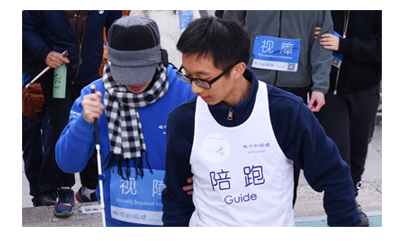
In July 2024, I attended a summer program hosted by the University of Chicago. Not long before that, I had founded a new student club at school dedicated to promoting accessibility and supporting people with visual impairments. Even while immersed in lectures and seminars in Chicago, I kept thinking about how to grow that initiative. One day, almost by accident, I stumbled upon the Chicago Lighthouse, a nonprofit organization that serves individuals who are blind or visually impaired. Founded in 1906, it has been operating for over a century and has offered a wide range of services, including low vision care, assistive technology, education, job training, and employment opportunities, which has covered almost everything for vision impaired people. I was deeply moved by its mission and impact, and I knew right away that I wanted to visit the organization in person.
I called the Chicago Lighthouse and was received by Mr. Aaron Baar, a senior director at the organization. When he learned that I was a high school student from Shanghai, China, he was very pleased and kindly arranged a tour appointment for me.
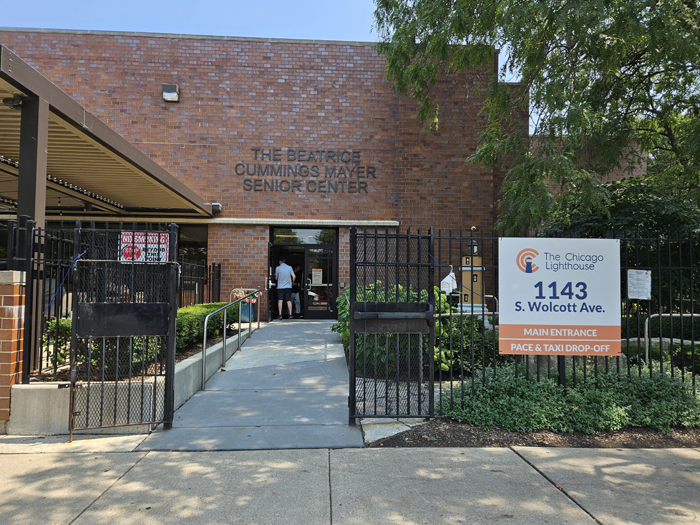
On July 30, 2024, I visited the Chicago Lighthouse, where Aaron gave me a comprehensive introduction to the organization. He told me that every year the Lighthouse serves over 50,000 individuals with visual impairments and is one of the most influential nonprofit organizations in Illinois. Aaron then guided me through their headquarters, which include activity rooms for visually impaired and disabled people of all ages, research laboratories, as well as offices and small-scale factories that provide employment opportunities for those with visual impairments.
In one activity room, Aaron introduced that this room is for children who have both visual and intellectual impairments. They receive personalized education with specialists from The Lighthouse. He also explained that children who have visual impairments but no intellectual impairments usually attend school alongside their sighted peers. Most of their classes are the same, and they receive assistive technologies in the classroom. In addition, they take specialized courses such as learning to read and write in Braille. This kind of educational system enables children with visual impairments to begin integrating into society from an early age.
At the Lighthouse research lab, I met Patricia Grant. Her team is working on how to use implanted brain-machine interfaces to help visually impaired individuals regain partial vision. Currently, test subjects are able to perceive brightness and temperature in certain areas of their visual field, allowing them to tell which chairs in a row are occupied. In the most successful trials, participants have even been able to precisely pick up a tiny pill from a tabletop.
In an office, I also met a blind woman named Sandy Murillo. After earning a degree in journalism, she joined The Lighthouse as the head of a radio program. All the staff in her studio are either visually impaired or have intellectual disabilities. Their broadcasts focus on accessibility-related topics, share resources for people with disabilities, and tell stories from their lives. According to Sandy, they have produced fun episodes such as “How Visually Impaired People Barbecue” and “How Visually Impaired People Date.” etc.
As we walked by a window, Aaron pointed out a ten-story building under construction, just next to the headquarters where we were. Funded by the state government, this building is designed to provide affordable housing for low-income individuals with visual impairments. It is the first residential building in the U.S. entirely designed with accessibility in mind: high-contrast paint in the hallways, handrails on both sides, Braille for all text, and adjustable lighting to meet the needs of residents with varying degrees of visual impairment. Aaron smiled when he told me that at night, the top-floor room on one corner of the building will remain brightly lit – so that from a distance, it looks just like a lighthouse.
When we finished our tour, we had some conversation. I shared with Aaron what I know about visually impaired individuals in Shanghai and introduced some of the work of our BonVista Accessibility Club. Aaron expressed his appreciation for young people’s willingness to support the visually impaired, saying that this cause needs more fresh energy. He emphasized that people with visual impairments are just as equal as those with full vision, and that everyone should have the right to pursue what they want to do. All they need is a platform – and we should strive to become the builders of that platform.
Aaron and I exchanged contact information and agreed to stay in touch. I saw many visually impaired persons freely coming in and out of the building, and whenever they encountered difficulties, there was always someone nearby ready to assist. Many of them also moved independently throughout the building with the assistance of guide dogs.
After the tour, I stepped outside and noticed a small garden near the entrance. I found a bench where I could sit and rest for a while. That was when a particular scene caught my attention. A staff member – whom I’d describe as a facilitator – was patiently teaching a visually impaired person and an individual with an intellectual disability how to care for the plants. As he demonstrated watering, he gently guided them to count aloud from one to five to prevent overwatering. While leading them through the garden, he carefully observed their movements, offering support only when there was a potential risk, allowing them as much independence as possible. Throughout the lesson, he wholeheartedly praised and encouraged their efforts. Slowly but surely, both learners began to grasp the basics of gardening. I sat there for nearly half an hour, listening to the soft counting – “One, two, three, four, five”. In that moment, I felt a deep sense of hope, as if the world were quietly becoming a kinder place. Even now, that feeling lingers whenever I recall the scene. I could vividly picture the water flowing gently from the kettle and hear the counting echoing in my ears under the warm sunlight.