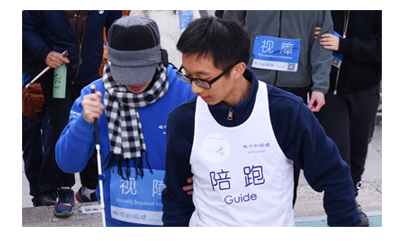
Scene 11: Documentary Interview with Quan Li, Principal of SUIS, Wanyuan Campus
More links:
The YouTube playlist for the documentary interviews
Interview Report
Over the past two years, SUIS (Shanghai United International School), Wanyuan Campus has been actively advancing accessibility awareness and community service education through close collaboration with the nonprofit organization Lanjingling. We had the privilege of interviewing Principal Quan Li to learn more about the school’s innovative initiatives, its educational philosophy, and the meaningful impact these efforts have had on students, teachers, parents, and the broader community.
Principal Quan recalled that the partnership with Lanjingling began two years ago with a focus on elementary students.
“We started with the elementary school. All students from Grade 1 to Grade 5 experienced a PE class under blindfold,” he said. “Lanjingling led our students in physical activities, allowing them to experience firsthand what it is like to rely on senses other than sight.”
Building on the positive response from this initial program, the school expanded the activities to include the entire student body.
“Our middle school students experienced a music class taught entirely blindfolded by Lanjingling.” Principal Quan explained. “For high school students, we organized a handicraft class where they learned to weave guide ropes, and we even transformed one of our underground dance studios into a pitch-black room for them to complete various tasks in total darkness.”
He added that teachers and parents also actively participated in many of these programs.
“You could say that over the past two years, we’ve carried out a large number of such programs,” he said.
When asked about the original motivation, Principal Quan emphasized the school’s commitment to deepening students’ awareness and empathy.
“At first, we simply thought: let our students experience some accessibility-themed activities.” he shared. “Our school has a community service month every March, and we needed meaningful things to do. That was our original intention.”
“Nowadays, many students lack awareness in this area. This turned out to be a wonderful way to raise awareness,” he said. “But experience alone is not enough. If our students can actually join in and contribute to community service efforts, work alongside others, or even just participate, the experience becomes even more meaningful.”
He explained how the school encourages students to take an active role:
“In the second phase of our collaboration with Lanjingling, we adapted all the programs Lanjingling offers, whether for adults, corporations, or the public, into activities that students could also experience. We encouraged more students to take part in organizing, initiating, and promoting these events, so they understand the challenges of community service work.”
Principal Quan was candid about the challenges involved in carrying out these innovative programs.
“Funding is a big challenge for every public welfare organization,” he noted. “There’s also the need to raise awareness in our community about how much community service helps children grow. Within the school, we have to keep promoting the idea and demonstrating it through various means, so everyone understands that this work is not easy.”
He shared a specific example of a practical challenge discovered through experience:
“In our cafeteria, teachers and students use regular trays with multiple compartments for different food items. But these trays are not friendly to people who cannot see clearly. One of our cafeteria aunties noticed this and started preparing large bowls mixing all the food together. This small detail showed how doing the activities reveals obstacles we might otherwise overlook.”
Principal Quan hopes that through repeated experience, the school community’s mindset will shift.
“Ideally, as these activities become part of everyday life, people will see things from new perspectives, their habits of judgment will change, and they will be more inclusive in their thinking,” he said.
In December 2024, the school held an inclusive charity concert featuring visually impaired performers alongside students.
“Our music department wanted to contribute to charity through the annual concert,” Principal Quan explained. “Since Lanjingling was already teaching music here and had invited blind musicians to perform, we decided to collaborate. We made the concert free for parents, set up voluntary donation QR codes, and invited visually impaired artists to perform.”
The concert drew 200 attendees.
“Everyone who came made a donation, some even gave twice,” he said. “This event raised funds and helped people understand the unique talents of these individuals. It also showed students that charity isn’t complicated: you don’t have to give a lot, just coming and supporting is an act of charity.”
Based on the concert’s success, the school plans to hold similar events annually.
In March 2025, the school organized a charity football match titled "He Ye Dao – Love at Wanyuan Charity Football Match," combining the school’s annual spring charity month and the parents’ football team activities.
“Inspired by the charity concert, the football team decided to turn the spring cup into a charity match,” said Principal Quan. “We invited teams from Shanghai and Wuxi, and asked players to donate to participate. We also invited members of the Shanghai blind football team to experience blind football with us, putting on blindfolds to take penalty shots.”
The event was met with enthusiasm from players, parents, and the community, raising funds and raising awareness simultaneously.
“It was very meaningful to experience how difficult it is for people with visual impairments, and everyone agreed to hold the event again next year,” he said.
Reflecting on the most memorable moments, Principal Quan recalled participating in a “Dark Room” experience with teachers and parents.
“Before going in, we were laughing and joking. But inside the pitch-black room, one of my teammates held on to me tightly, feeling very unsafe. It showed how much comfort just having someone nearby can bring,” he said. “After half an hour, our hearing became extremely sensitive, and we had to complete tasks relying only on sound. It was nerve-wracking but eye-opening.”
He highlighted how such experiences foster empathy and awareness:
“Participants said they had never experienced anything like this before. We used to walk past accessible features without noticing, but after this, we understood their importance. Through these activities, students and parents gain a clearer understanding of the real world and learn to care beyond themselves.”
Principal Quan expressed deep gratitude for the support from parents and the local community.
“Most charity events have been organized with tremendous from parents,” he said. “Many NGOs we work with were founded or run by our own parents. Our PTA members actively volunteer and promote these activities.”
He noted that support has grown over time, with increasing student and parent participation in charity trips and collection campaigns.
“Even local community groups like Gumei Park and Zhixiang Kayak Club have been introduced through our school and parents,” he added.
When asked about what charity work offers students that classroom learning cannot, Principal Quan was emphatic.
“Charity work provides experiences children wouldn’t encounter at home or in textbooks,” he explained. “Schools must create platforms for children to face real-life situations and genuine human interaction. Community service teaches kids to care for others and try to make a difference, something that sports and arts alone can’t replace.”
He summarized the character-building aspect:
“Kids who consistently volunteer without rewards are reliable. They are driven from within, overcoming difficulties on their own. Our goal is to cultivate reliable students, which is also important when hiring teachers.”
The school has received overwhelmingly positive feedback from students, parents, and teachers.
“No parent has told me these activities take away from homework. Instead, they feel it’s well worth their children’s time,” Principal Quan said. “The level of support and awareness around community service has risen dramatically in the past two years.”
Looking ahead, he expressed the school’s aim to make these programs more professional, engaging, and accessible.
Regarding inclusive education trends, Principal Quan was optimistic.
“As society develops, attention shifts toward vulnerable groups. Integration of children with special needs into mainstream education is already happening across basic education levels,” he said.
He highlighted the importance of student-led initiatives.
“We want students to take ownership and promote these efforts through clubs, experiencing the joy of growth themselves,” he stated. “This empowers them to plan, lead, and contribute.”
Finally, Principal Quan offered encouraging advice to young people eager to serve:
“Doing is everything. You might hesitate or have doubts, but taking action is the most important step. As you keep doing, you’ll open new doors and experience more joy and fulfillment. Doing itself is the answer.”