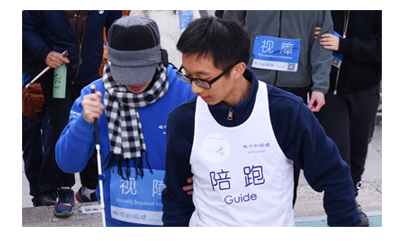
Scene 10: Documentary Interview with a Teacher from Shanghai Blind Child School
More links:
The YouTube playlist for the documentary interviews
Interview Report
Nestled in the heart of Shanghai stands a quiet but extraordinary institution: the Shanghai Blind Child School. Founded in 1912, it remains the city's only comprehensive educational center exclusively serving visually impaired students, spanning kindergarten to high school in a unique 15-year education system.
We had the honor of speaking with a senior teacher at the school, Ms. Xu, a high school Chinese teacher who has worked here for 32 years. Her voice carries the warmth of experience and the steadiness of long service.
"Our students are children first. Whether they are fully blind, low vision, or have additional disabilities like cerebral palsy or hearing impairment, we treat them all with dignity, with a goal of helping them live as independently and meaningfully as possible."
Ms. Xu told us that students must have evaluation by a professional institution to be admitted. Only those with corrected vision below 0.3 qualify are admitted, and among them, some also face additional physical or cognitive challenges. Based on their needs, students are grouped and placed in specialized divisions where individualized support is provided.
"We don’t just teach subjects. We provide magnifying glasses, electronic visual aids, large-print books, Braille textbooks. Even every child’s desk has a computer that syncs with the blackboard to help them see."
Academically, the school adheres closely to the national curriculum. Students study Chinese, math, English, history, physics, chemistry, biology, geography, just like in mainstream schools. Ms. Xu added:
"The difference lies in how we teach. Blind students first learn Braille. Those with low vision get enlarged materials. For subjects like geometry or chemistry, which rely heavily on spatial and visual understanding, our teachers rely on verbal description and creative aids."
But education here goes far beyond textbooks. Courses in crafts, music, and life skills are integral.
"Our students learn carpentry, paper art, even cooking. Music is deeply developed. We have a orchestra and a choir that has performed internationally."
One standout course is "Directional Walking."
"We teach our students, especially those fully blind, how to navigate independently. With a cane, they learn to take the subway, go to the supermarket, even cross intersections. We want them to be ready for society."
The school also includes extensive extracurriculars: Lego, 3D printing, sports like blind soccer and ping pong, flower arrangement, photography.
"Some wake up early and run laps around the field by themselves. Others learn to swim or even become museum docents. They want to be seen for their abilities."
Thanks to modern technology, blind and low-vision students now have greater access to reading and learning than ever. Ms. Xu told us:
"They use screen readers to listen to books at speeds of 200 words per minute. We provide accessible textbooks adapted nationwide by the Ministry of Education. Blind textbooks can be enormous. For an example, one Chinese test may be 30 pages. Some students even carry homework in trolleys instead of backpacks."
School begins at 7:30am with a morning meeting, followed by four classes, physical exercise, lunch, and three afternoon classes. After 3:30pm, students engage in clubs and activities. Many live on campus with full support.
"Our students love school. Some even ask during home visits in the summer vacation when they can return. It's their safe space, their community."
Ms. Xu emphasized that psychological support is important. Each student is paired with a mentor and the school encourages head teachers to become certified counselors.
"When a student suddenly goes blind, it’s devastating. We once had a 12-year-old who lost his sight overnight. He joined us in despair but quickly passed Braille exams and jumped to 6th grade. He eventually graduated from ECNU (East China Normal University) and is now in a postgraduate program at the University of Hong Kong."
Families receive support too, like eye care, emotional guidance, and equitable treatment of siblings.
"Sometimes the visually impaired child is neglected in favor of a sighted sibling. We help parents understand the importance of balanced attention."
Students take the high school entrance exam just like their peers in mainstream schools. If they qualify, they attend high school or pursue vocational tracks like massage or piano tuning. Some continue to university, notably at ECNU (East China Normal University), SUFE (Shanghai University of Finance and Economics), and SSPU (Shanghai Polytechnic University), studying social work or English. Ms. Xu told us proudly:
"We have alumni who became teachers, psychologists, even tech entrepreneurs. One founded a company that developed the famous 'Questionnaire Star' survey software."
And some return to teach.
"Four of our teachers are blind or low vision alumni. They came back because they believe in this place."
Ms. Xu highlighted the school’s commitment not only to students but also to their families, ensuring a comprehensive support system.
She then explained how inclusive education works abroad:
In countries like the United States, visually impaired children often go to regular schools and study with sighted classmates. They have special teachers who go from school to school to support them.
She then described Shanghai’s own program:
Our school is part of the Visual Impairment Education Guidance Center. We go to mainstream schools, talk to teachers, learn about the child’s eye condition and family situation, and sit in on their classes. Then we provide support, whether it’s large-print textbooks or advice on seating. If a child has albinism, they need to sit in a dim corner. Others might need to sit by the window or use a personal lamp. It’s our job to make sure they have the tools and environment they need to learn.
Besides supporting teachers, they also counsel parents:
Some parents think, ‘My child is in a regular school, so he’s normal.’ But they don’t realize how vision loss can affect academics. We have to talk to them, explain the difficulties, and sometimes provide psychological support.
Ms. Xu shared how teachers juggle multiple roles:
We’re not full-time itinerant teachers. We have our own classes here at the school, and we set aside time every week to visit other schools. It’s hard work.
When asked about the future of inclusive education, Ms. Xu reflected:
Most children in regular schools have low vision, not total blindness. Blind children need Braille, and regular school teachers generally don’t know Braille.
She cautioned about challenges:
As academic pressure increases with age, some children’s eyes simply can’t keep up. For example, a brilliant student with 0.05 vision struggled in high school and transferred to our school in his third year.
She stressed individualized decisions:
We analyze each child’s situation and advise parents. Sometimes they’re hesitant, worried about stigma, but we invite them to visit and observe before making the choice.
Sharing a success story, Ms. Xu recounted:
A boy who struggled for years in a regular school was neglected and unable to read a sentence properly by junior high. He barely knew English letters. But he was smart and willing to learn.
Our teachers contributed extra time to tutor him. He made it to high school, then university. Now he has a job. We didn’t just change a student’s life, and more importantly, we changed a family’s future.
She also spoke about government support:
There’s huge investment in special education. Every student has a computer, large desks, reading booths, even smart lending robots in our library.
And the important role of social organizations:
We receive donations, scholarships for outstanding students, and funding for sports and music programs.
Ms. Xu candidly discussed current difficulties:
The class I’m teaching now includes an autistic child with visual impairment who is emotionally unstable. I’m learning how to communicate with him and his parents.
Another child has heart problems initially ignored by his parents. After coordination among staff and the principal, he was diagnosed with autonomic nervous disorder. We’ve even called 120 to take him to hospital.
She described how the school acts beyond teaching:
Sometimes I help blind parents with errands or visit them when their child is hospitalized. Sometimes you’re not just a teacher, but a caregiver as well.
Finally, Ms. Xu shared what motivates her:
Children are incredibly close to their teachers. Once, I sprained my ankle and came back limping. The students had already placed a chair by the podium and said, ‘Teacher, sit down while you teach.’ I couldn’t hold back my tears.
Many students live at school. For some, we’ve been with them from kindergarten through high school for 13 to 15 years. The bond is very deep.
When asked about her greatest wish, she said:
Although I’m a teacher here, I hope there will be fewer children with visual impairments in the future. And for those who do, I hope they get a better education, are treated equally, and live happy lives after graduation.
I want to see our students go to college, fall in love, build families, and live lives just like anyone else.