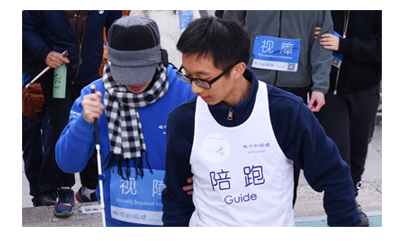
Scene 9: Documentary Interview with an Accessibility Facilitator
More links:
The YouTube playlist for the documentary interviews
Interview Report
Among Lanjingling’s volunteers, there’s one person affectionately known as “Captain.” His real name is Wei Zheng, but everyone calls him Beiwei. He’s a longtime supporter of the beYoureyeS initiative, since its very first session nearly a decade ago.
“I’ve actually been involved since the very beginning,” he says with a quiet smile. “So I guess you could say I’m a bit of a veteran.”
As one of the most experienced volunteers, Wei Zheng has taken on many roles over the years, including organizing and coordinating the regular weekend running events. But the title “Captain” didn’t come from any official appointment. It started, as many great things do, by accident.
“In our second year, I began organizing informal weekday runs. The participants include just a few of us, visually impaired friends and volunteers who had participated before. We created a WeChat group, and people just started calling me ‘Captain.’ Over time, it stuck.”
Behind the easygoing title, however, lies deep dedication. Wei Zheng is also a Baymax evaluator, named after the gentle, caring robot from Big Hero 6, responsible for training and assessing new volunteers.
“At first, we had no model to follow,” he recalls. “Jiyuan and Xiangdong gathered resources from Hong Kong and Taiwan. Everything was experimental. In the first year, our top priority was safety. We emphasized protocol, communication, and proper training.”
New volunteers were first called “Little Baymax.” After proving themselves through experience and evaluation, they could graduate to “Baymax.”
“After about three months, I was allowed to take the Baymax evaluation. Eventually, I even helped revise the system. Originally, it was just ‘Little Baymax’ to ‘Baymax’ but that jump was too big. So I added steps in between, which provided more opportunities for learning, trial and error. Becoming Baymax isn’t the end. It’s just the beginning of doing more.”
When asked what matters most in guiding a visually impaired runner, Wei Zheng pauses, then says simply:
“There are two parts. First, to be a person. Just be a person talking to another person. Only after that do you consider they are people with visual impairments. Just like you meet a new friend. Then, you learn to guide.”
He emphasizes real communication over empathy, companionship over control.
During our interview, he demonstrates a guiding session, patiently explaining each motion: how to describe an upcoming step, how to avoid vague phrases like “here” or “this way,” how to give space and build trust.
“When we’re walking together, we lead with both voice and body. If there’s a step, don’t just say, ‘There’s a step’, which doesn’t help. Say, ‘There’s a downward step,’ and then lead.”
He shows how to adjust for narrow paths, how to switch guiding positions, how to handle low branches, and how to introduce a seat:
“Tell them, ‘There’s a chair to your left.’ Let them reach out and feel it. They’ll decide whether it has a backrest, how high it is. We’re here to provide visual information, not to control them.”
As the session transitions into a running tutorial, Wei Zheng introduces the running tether, which is a soft loop held by both guide and runner.
“The person with the visual impairments wears the loop on their wrist and holds it firmly. The guide just holds it gently, close to the loop. That way, in an emergency, the guide can let go without dragging the runner down.”
But what matters most, again, is rhythm and communication.
“Run together. Match your arm swings. Feel the rhythm. That’s how you guide direction: through sync, not control.”
In a world that often over-engineers assistance, Wei Zheng brings it back to the human core: respect, humility, and connection.
“Like Baymax, it’s not about being strong or cute. It’s about using what you have to bring warmth and safety to others.”