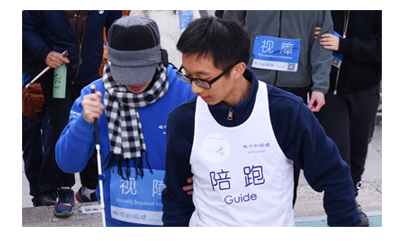
Scene 3: Documentary Interview with Xiaobin, A Person with Visual Impairment
More links:
The YouTube playlist for the documentary interviews
Interview Report
BonVista Accessibility Club recently had the honor of interviewing Chen Xiaobin, a visually impaired person and an seasoned facilitator in non-profit organization Lanjingling. Xiaobin shared with us his student years, professional pursuit, and reflections on accessibility.
Chen Xiaobin introduced himself by saying:
“My name is Xiaobin. I'm a visually impaired person. I still had some eyesight when I was a child. It was about in my junior high school that my vision began to decline rapidly.”
Diagnosed with congenital glaucoma, Xiaobin retains only a weak light sense. He was in a blind school and later successfully attended the college entrance examination, and then became one of the first visually impaired students in Shanghai to enter university through this route. His major is psychology.
“In the university, in addition to learning knowledge, I had to walk into a simulated environment close to real society. I needed to be more independent to deal with accommodation and dining. I familiarized myself with going to the cafeteria independently. When I ordered the meal, I asked students what was on the menu and asked others to help when carrying my tray.”
Xiaobin’s connection with Lanjingling began in 2015 when he participated in their first weekend inclusive activity.
“I didn’t know what guide running or accessibility meant at that time. I just wanted to work out and communicate with people.”
From running a few hundred meters, he gradually built up to 5 km and then 10 km. Over time, he became not only a participant but also a guide running trainer and an event organizer. He reflected:
“I found out later that training sighted people with accessibility awareness was my interest. I began teaching how to guide the visually impaired and how to guide running.”
He later became deeply involved in event planning, implementation, and post-event summaries. Importantly, he contributed to Lanjingling’s “100-Day Engagement” initiative, which helped over 30 visually impaired persons achieve inclusive employment.
“As a visually impaired person, I found my platform to develop my abilities.”
The Lanjingling website praised him that “his independence, resilience, and self-driven spirit are always the most radiant colors in Lanjingling.”
When asked about challenges he faced in his work, Xiaobin highlighted two major types: technical and organizational.
“Some difficulties came from accessibility issues – like using Word typesetting and complex Excel functions. I had learned them but didn’t use them often. So when special projects came, I looked them up on Baidu and practiced.”
Organizationally, with limited reference materials and increasing project complexity, innovation was the key.
“We brainstormed in pre-meetings and tried to be creative. It was a process of growth and gradual learning.”
When asked how he defined the accessibility, Xiaobin highlighted equality and inclusion:
“Equality means giving people with different characteristics the same possibility to participate in social life. Inclusion presupposes equality. It’s not charity from a superior to an inferior, but working together to make life more accessible for everyone.”
He praised Shanghai’s subway system for offering better accessibility support than Hong Kong in some areas, such as quicker staff response. However, he also noted:
“Audible traffic lights are very popular in Hong Kong. In Shanghai, public acceptance and awareness may be slightly lower.”
Xiaobin also pointed out some barriers to independent travel for visually impaired people:
“One reason is insufficient accessibility support. For example, blind paths are often blocked by bikes or scooters. Another is that visually impaired people might have weaker desire to go out, partly due to family concerns.”
When traveling independently, Xiaobin sometimes encountered difficulties:
“Occasionally, I got lost due to navigation errors or missed stops because of delayed announcements. The worst situation is when there were few to none passersby, it was hard to ask for help.”
Despite these issues, Xiaobin is able to commute to work on his own, mainly by subway, which takes about an hour and a half.
Xiaobin emphasized the importance of visual impairment etiquette:
“Sometimes people push me ahead without saying anything. Once, someone pulled my bag when I was entering the subway. It felt uncomfortable and unsafe.”
He also mentioned well-meaning overprotection:
“Subway staff sometimes insisted I take the accessible elevator, even when I knew the way and was capable of using the escalator. I had to explain I was familiar with the route.”
Xiaobin enjoys reading online novels, listening to music and crosstalk, and browsing short videos. He uses apps like WeChat, TikTok, DingTalk, QQ, and Alipay, relying mainly on screen readers.
He commented on challenges in information accessibility, especially with evolving CAPTCHA formats:
“Some image-based CAPTCHA or voice CAPTCHA in English are impossible to complete. It’s a significant barrier.”
Braille e-readers, he noted, are uncommon due to high cost and limited utility compared to voice alternatives.
Xiaobin expressed gratitude for his supportive family:
“My parents support everything I do. After work, they pick me up at the subway station even though I can walk home. I understand their concern and let them do it.”
When asked about his wish, he shared:
“My wish is to make our environment more accessible. When the environment is accessible, life will definitely become more convenient -- actually that will benefit everyone.”