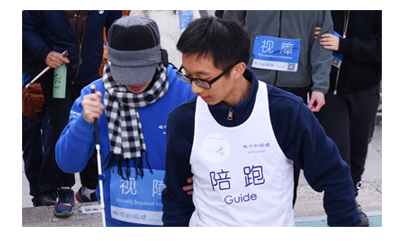
Scene 1: Documentary Interview with Wang Qu, a person with visual impairment
More links:
The YouTube playlist for the documentary interviews
Interview Report
Qu Wang, a visually impaired massage therapist from Shanxi Province, has been living and working in Shanghai for over a year. With a weak light sense that allows him to perceive object outlines and colors, Qu moved to the city in early 2024 in search of more career opportunities and greater inclusion.
“I came to Shanghai to broaden my professional boundaries,” he said. “I want to explore more possibilities beyond traditional massage.”
Qu first visited Shanghai in late December two years ago, when he participated in a seven-day training camp organized by a non-profit organization. The experience left a strong impression. In early 2024, he made the decision to officially relocate to Shanghai for work.
Today, he is employed at a community hospital in the city, continuing his work in traditional Chinese medicine massage – a common profession among blind individuals in China. Despite his visual impairment, Qu lives and commutes independently.
“When I go to work, I usually take the subway like most other workers,” he said. “I travel on my own.”
Qu described his level of vision as being between total blindness and low vision. While he is unable to take a standard vision test, he can still detect light, see object contours, and distinguish colors. He noted that among people with light perception, there are a range of visual conditions. Some can only detect light and dark, but cannot perceive shapes or colors.
The journey from Shanghai to Shanxi takes Qu about 16 hours in total. He first takes a high-speed train for about 90 minutes, then transfers to a slower train due to a lack of direct connections.
Life in Shanghai has offered him not only work opportunities, but also social participation.
“There are more activities for visually impaired people in Shanghai than in second- or third-tier cities,” he said. “For example, there are public welfare events on weekends. I’ve gone with friends to museums and scenic spots.”
He recalled a visit to Jing’an Temple with friends in 2023. “The staff were very respectful and had a good understanding of how to support people with disabilities,” he noted.
In terms of daily life, Qu adapts flexibly depending on his schedule. On weekdays, he often eats out for breakfast and lunch and cooks dinner himself if time permits. On weekends, when he has more time, he prefers to cook at home. He buys food and daily necessities both online and in local supermarkets or vegetable markets. When moving to a new neighborhood, he uses his phone to look up nearby stores and navigates there using maps.
“Sometimes I ask for help when I’m shopping on my own,” he said, “but overall, I can handle it independently.”
Though he continues to practice massage professionally, Qu is actively preparing to transition into the technology industry. He hopes to work in digital product sales, particularly with mobile phones and computers.
“The position I most want is in digital tech sales,” he said. “For example, a job at the Apple Store. If companies like Huawei, Xiaomi, or Vivo opened such positions to people like me, I’d be very eager to try.”
To support this goal, Qu has been teaching himself programming and has developed his own learning method.
“I open a document on one side of the screen and a code editor on the other,” he explained. “I read the tutorial, then switch over and write the code myself. Then I switch back. I repeat this over and over.”
He has been using platforms like Bilibili and WeChat Reading to find tutorials and Python programming resources. He thinks text-based learning can actually be more efficient for visually impaired learners than video.
“Video tutorials aren’t always helpful for us,” he said. “Reading and writing code directly is often more effective.”